

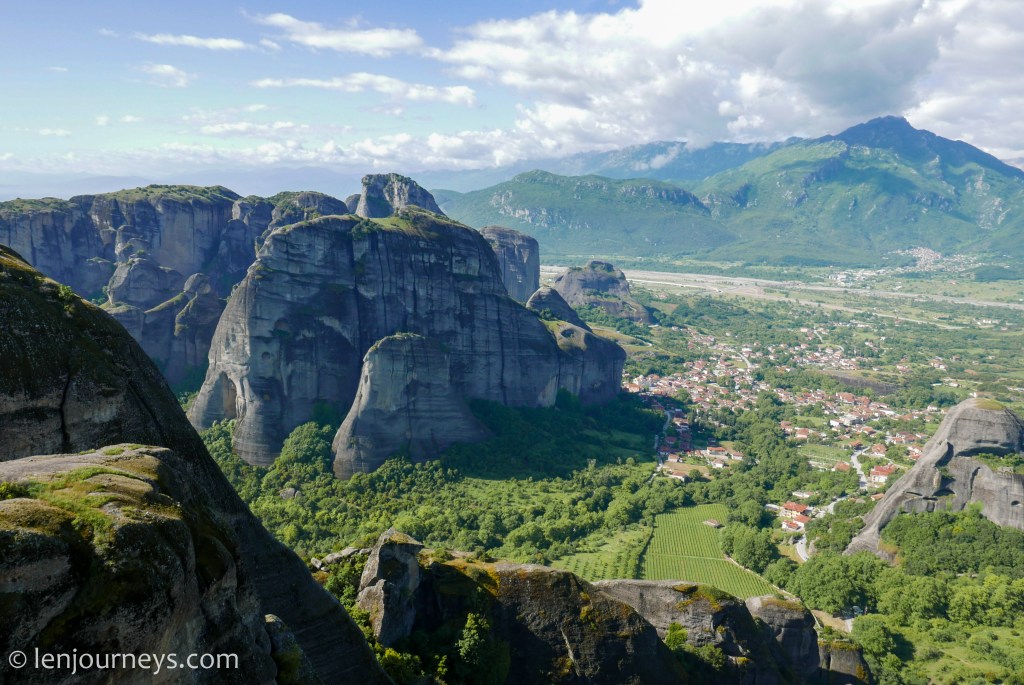
Even in a country steeped in mystery and myth like Greece, Meteora is still one of the most surreal places. It’s a collection of gigantic monoliths that jut 600 meters toward the sky. Perching on top of them are medieval monasteries, which have long been the destinations for spiritual accession.
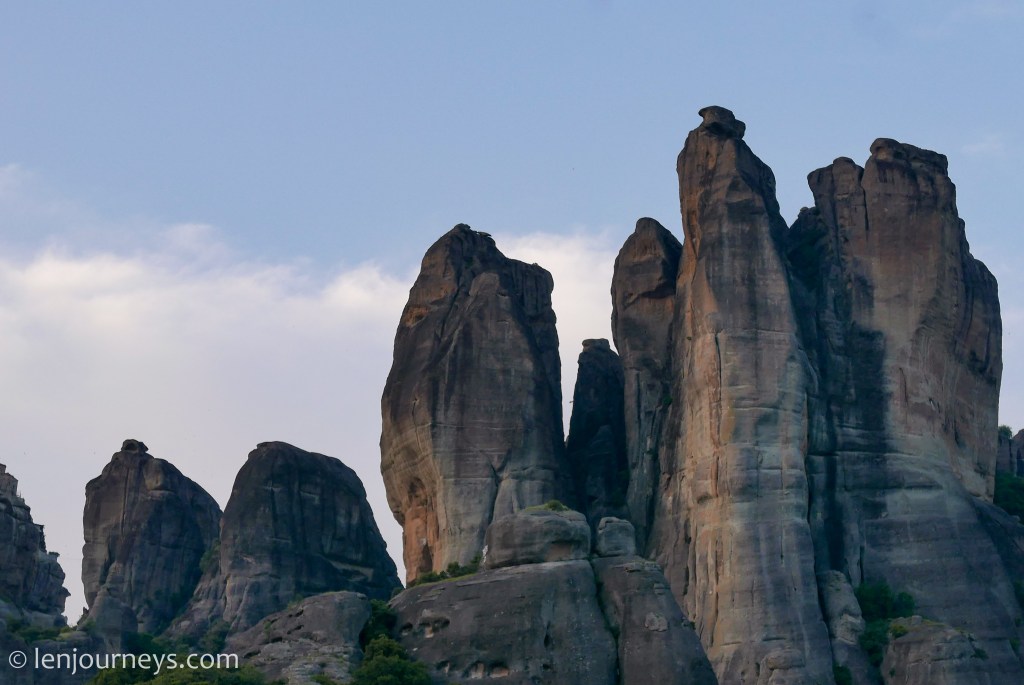
It’s hard to imagine a more impressive view than opening your windows to see Meteora’s forest of rock pillars. The dark grey peaks abruptly rise from the lush green plains of Thessaly, shooting up to 600 meters into the sky. Eons of geological and environmental activities have formed this surreal landscape. We can think of a massive high plateau being cleaved by earthquakes, shattering them into large rock formations. Then, water and wind eroded the rocks over millions of years, forming today’s buttes.
Due to the inaccessibility of these columns, Meteora was regarded as an ideal place to connect with the divines through absolute solitude. The treacherous location was also a clever way to keep the churches safe from invaders. Henceforth, despite tremendous difficulties, twenty-four monasteries were built atop these pinnacles between the 14th and 16th centuries.
A forest of enormous rock columns.
Over time, only four monasteries and two convents are still active, with few monks and nuns residing there. They establish Greece’s second most important monastic community, preciding by the sacred Mount Athos. Each is an architectural gem, representing the harmony between human skills, godly devotion, and nature’s grandeur. For this uniqueness, Meteora’s monasteries and their surrounding landscape have been designated World Heritage Sites by UNESCO since 1988.


1. The Great Meteoron
Perching on majestic cliffs, the Great Meteoron is the oldest and largest of all Meteora’s monasteries. Its name was either derived from the Greek words meteoros (lofty) or its founder, Saint Athanasios the Meteorite, a monk from Mount Athos. Either way, the monastery was established just before the mid-14th century. The 16th century was the golden age of the monastery as it accrued imperial and royal donations. It also attracted numerous devotees, with more than 300 monks seeking hermitage there.
Having an Anthonite origin, the Great Meteoron was constructed like a medieval fortification, with high walls and watch towers guarding a narrow entryway. It opens into a central courtyard with a phiale for blessing waters and the katholikon (main church). This structure was the first to be built in the complex and boasts frescoes depicting the Transfiguration of Jesus.
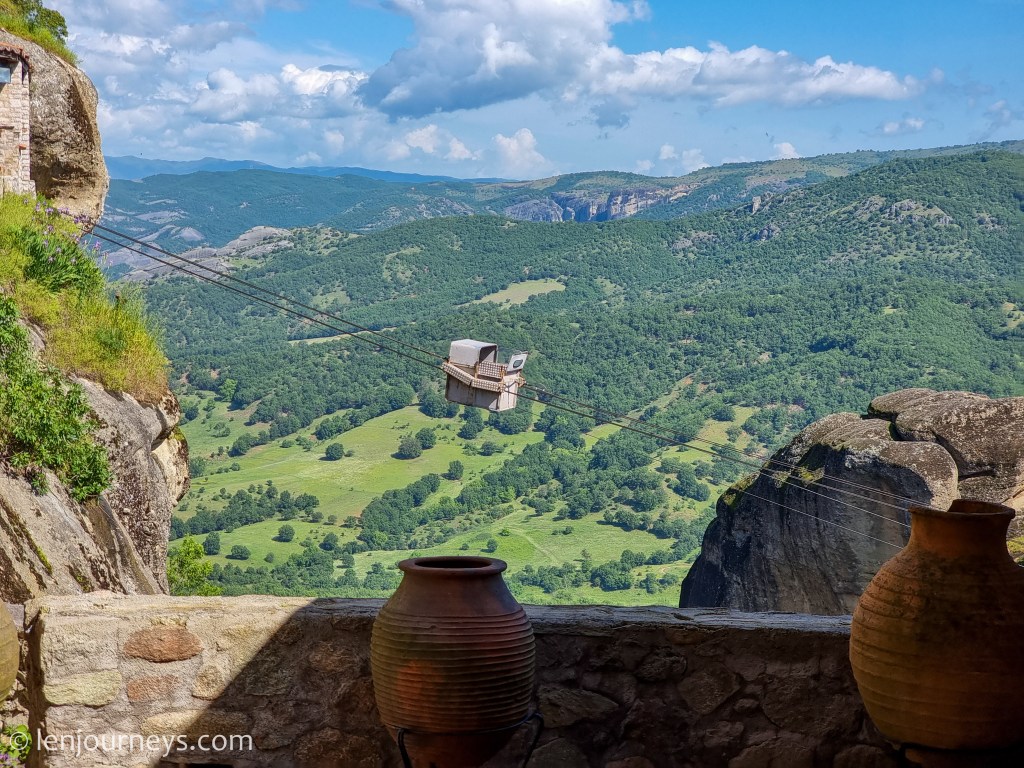
Surrounding the spacious courtyard are the abbot’s quarters, monk’s cells, and other auxiliary structures. For example, the dining hall, the domed kitchen, and a clinic with classical red-brick roofs. Yet the most intriguing part is the elevator system that features a metal “basket” suspended in the air. It’s hanged on two ropes and then pulled in by the residents. In the past, monks lifted their stuff and even themselves by using this old-age system.
The oldest and largest monastery in Meteora.




2. The Varlaam
Right next to the Great Meteoron is the Varlaam – the second-largest monastery in Meteora. This monastery takes its name from a monk named Varlaam. He was the first to scale the imposing rock outcrop on which the building was erected around 1350.
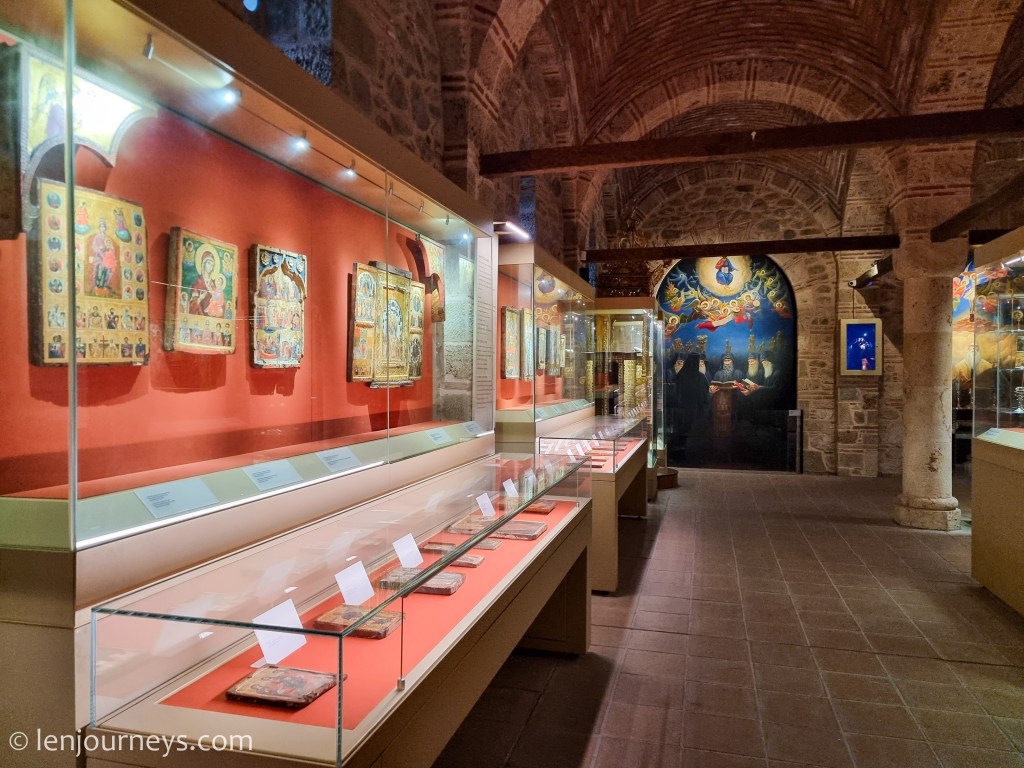
Safeguard to relics and sacred texts.
The site was abandoned for nearly two centuries until two other monks, Theofanis and Nektarios, hoisted materials up the face of the cliffs and rebuilt the church in 1517. Twenty-two years was the time needed to complete such an extremely laborious task.
Like the Monastery of Great Meteoron, the Varlaam was designed like a fortress. It contains many structures, including a katholikon, a well-kept garden, hermits’ living quarters, and a communal kitchen where a massive wine barrel is located. Yet the Varlaam is also responsible for many invaluable relics, ancient texts, and ecclesiastical treasures.




3. The Roussanou
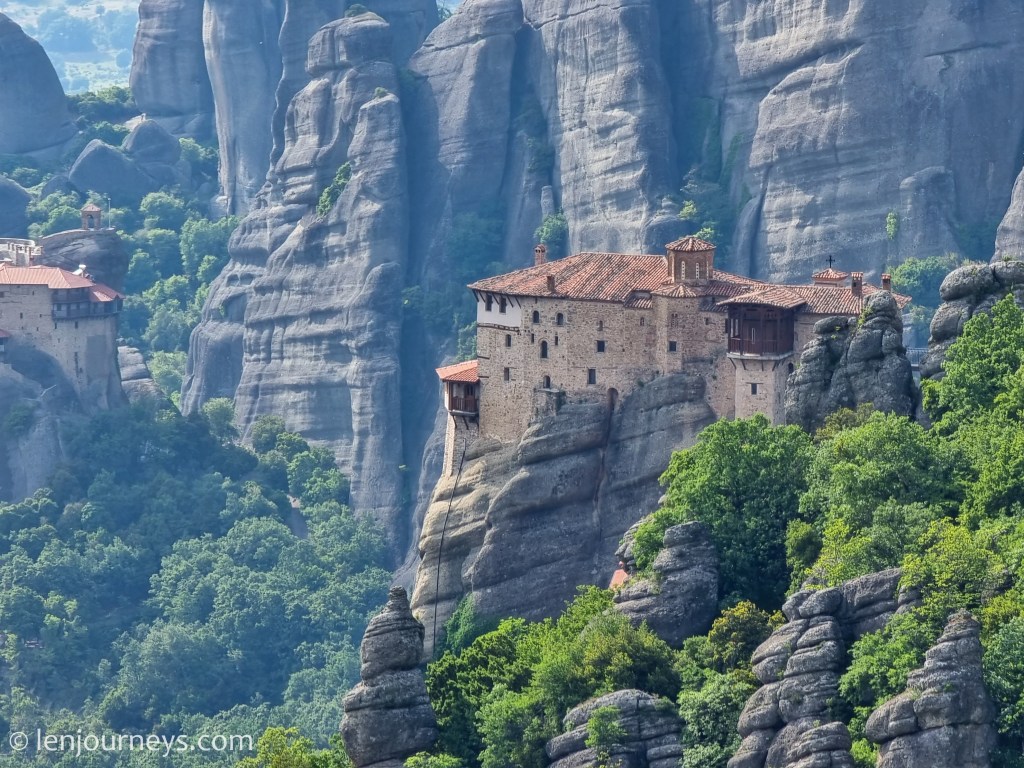
Covering the entire top of a rock pillar, the Roussanou is one of the two convents in Meteora. It was first established by a group of monks who reached the summit in the 14th century. However, by the end of the 1980s, the structure was converted into a convent so that women could also seek hermitage in this holy place. From afar, the structure looks as though it was carved out from the rock itself.
In comparison to the two previous monasteries, the Roussanou stands at a lower elevation. It’s also more compact, containing only a three-story building. The third and second floors are occupied by reception halls and an exhibition room, while the ground floor is reserved for the katholikon, the nuns’ cells, and a charming flower garden. All of these were built on a backdrop of lush green forest.


4. The St. Nicholas Anapafsas
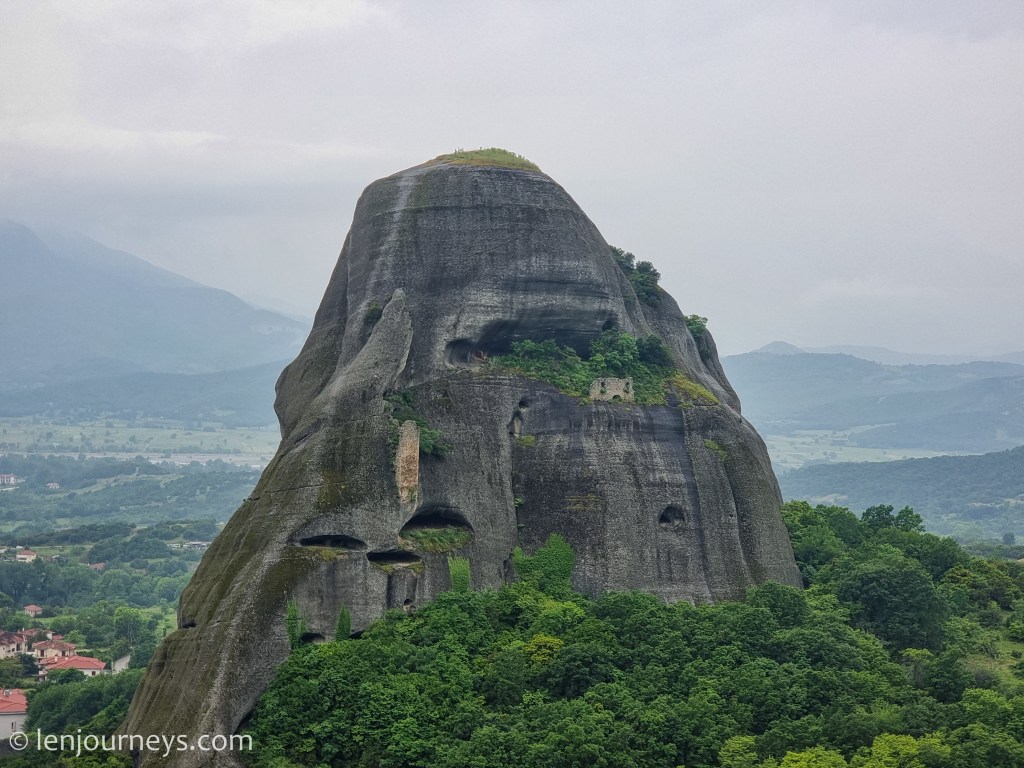
The Holy Monastery of St. Nicholas Anapafsas was the first place in Meteora, where I encountered difficulties ascending. The spring downpours made the stairs slippery, and on a few occasions, there were even falling rocks. But in the past, the journey is believed to be perilous. There were no steps to climb up the 80-meter-high pinnacle, only rope ladders and perhaps a lifting net.
Established in the late 14th century, this monastery served as the first resting place for pilgrims when they arrived at Meteora. Hence the name Anapafsas refers to the Greek word anapafseos, which means “resting”. Throughout history, the edifice underwent significant changes, with the most recent renovation being performed in the 1960s.
The resting place for pilgrims.
Once reached the top, a narrow entrance opened to the reception area and the katholikon where St. Nicholas is honored. Similar to the Roussanou, this monastery was built vertically because of the limited surface at the summit. It contains multiple floors and they are connected through an interior staircase. The upper level has a veranda that offers a spectacular view of the landscape and ruined monasteries nearby.



5. The St. Stephan
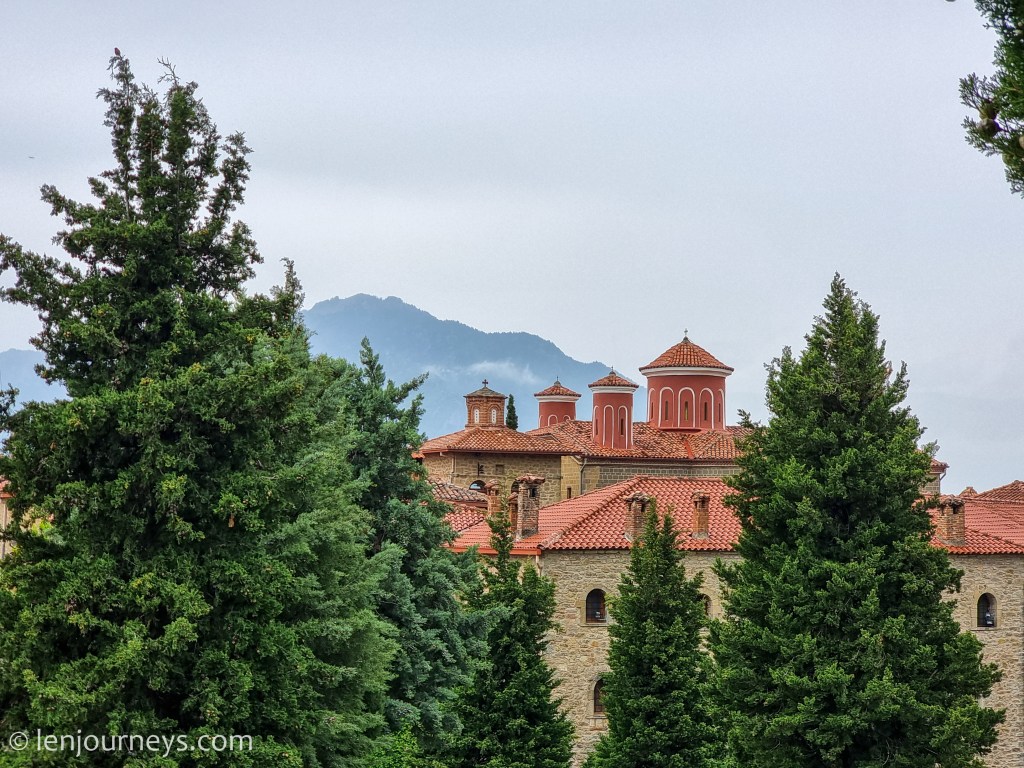
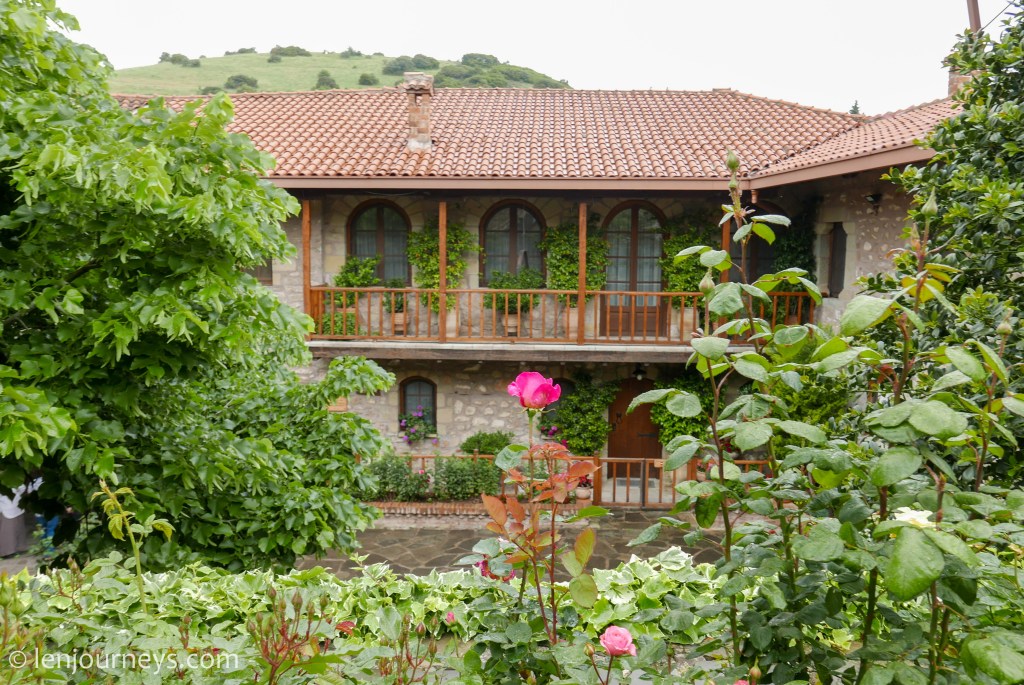
Positioned on a butte at the southern edge of the rock cluster, St. Stephan is Meteroa’s first all-female monastic community, established in the 1960s. It’s also the most accessible structure in the area as visitors only need to cross a small bridge to reach the entrance. The convent dates back to the mid-15th century when a pair of devotees rebuilt an old chapel at the peak. During the two World Wars, the St. Stephan suffered heavy bombardments, severely damaging the architecture. Fortunately, most parts have been retouched and restored.
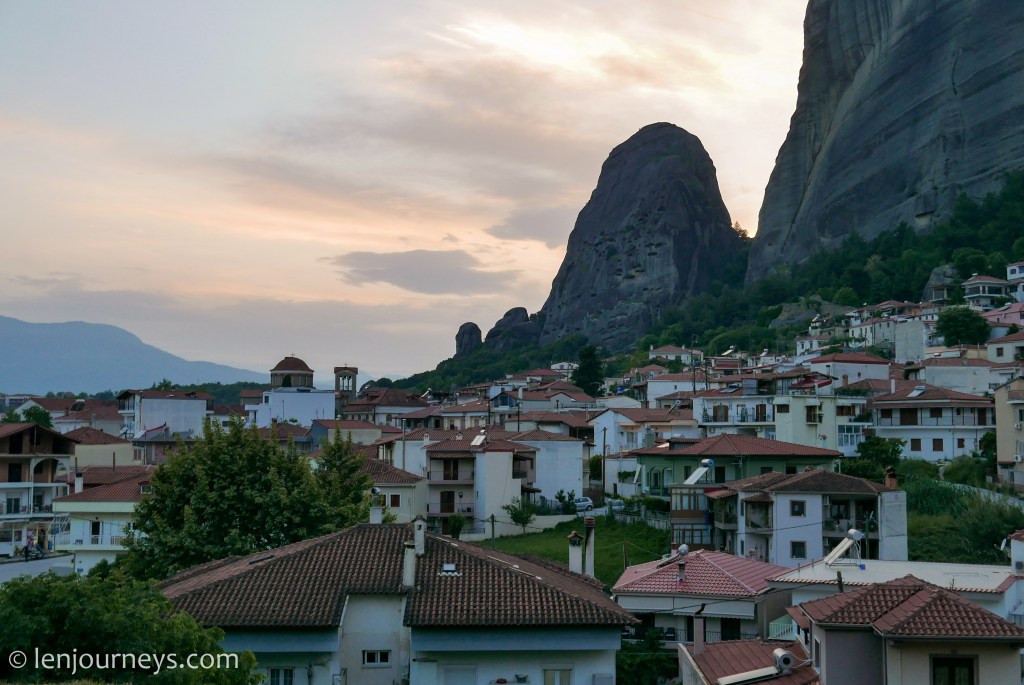
Like other large monasteries, St. Stephan features a central courtyard with captivating views over the red roofs of Kalabaka and the picturesque Thessalian valley. Around it are the nun’s cells, workshops, a kitchen, and other auxiliary rooms. Interestingly, there is not only one but two katholikon in the convent. The 15th-century old church is reserved only for important religious ceremonies. Meanwhile, a new katholikon was built in 1798, making it the newest of all the structures in Meteora. Its interior remained plain until the 1980s when the famous Greek painter Vlassios Tsotsonis started to adorn it with unique frescoes.


6. The Holy Trinity

In contrast to St. Stephan, the Holy Trinity is the most difficult to reach. It stands atop a slender rock column accessible only by 145 carved stone steps. But before starting the climb, visitors have to cross a narrow path downhill until the foot of the cliff. Due to its extraordinary position, the Holy Trinity was chosen as the film set for the James Bond movie “For Your Eyes Only” produced in 1981. And now, it is the most photographed monastery in Meteora.
7. Church of the Dormition of the Virgin Mary
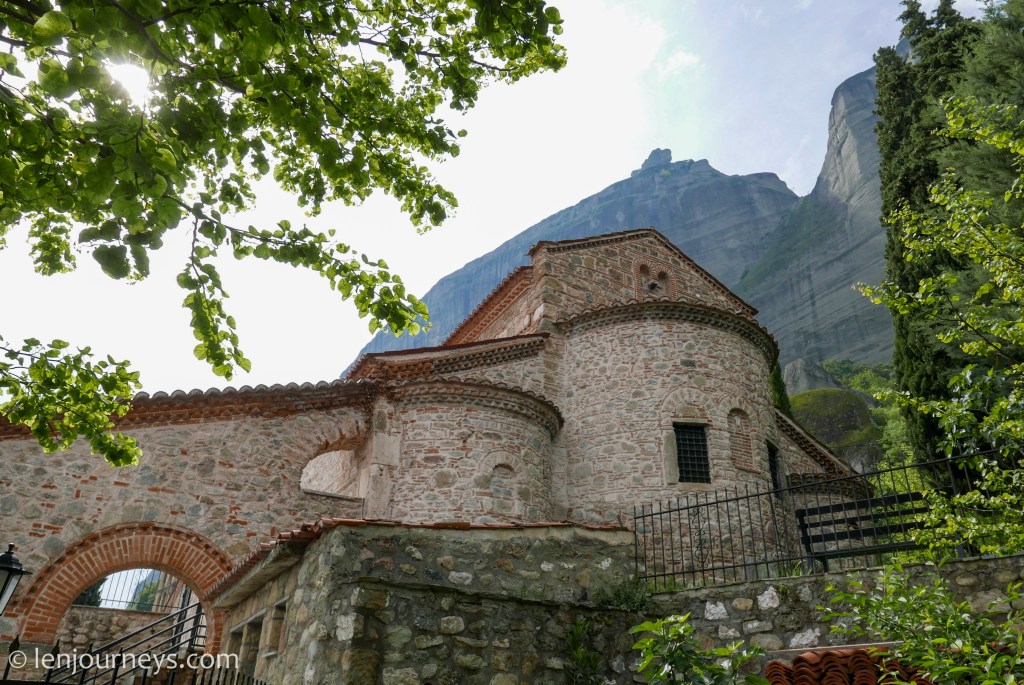
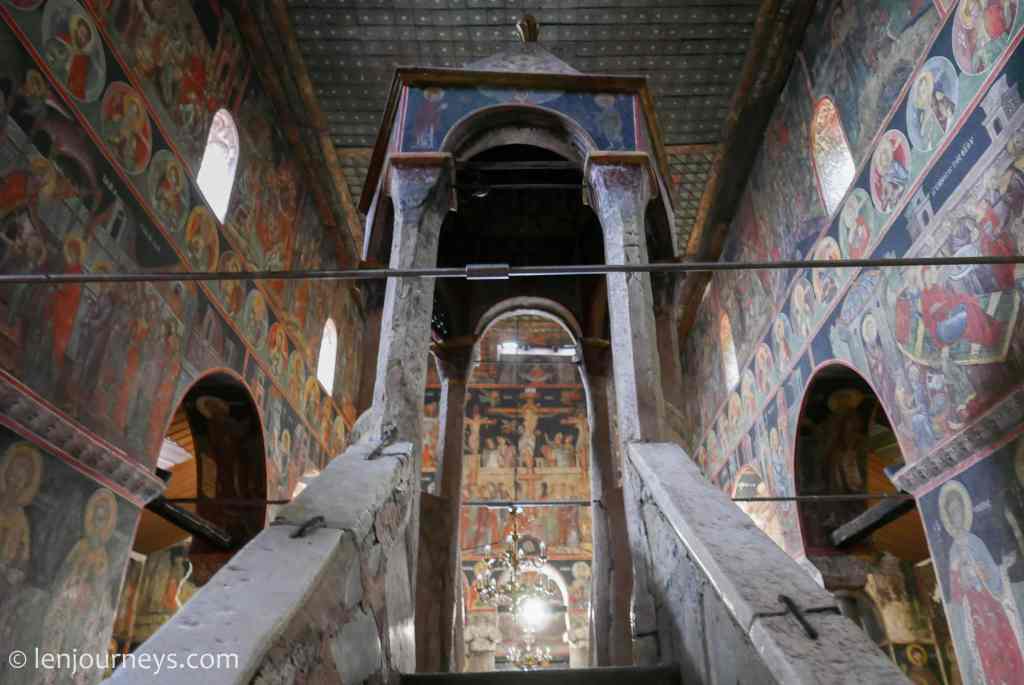
Though not boasting an impressive setting like the six monasteries, the Church of the Dormition of the Virgin Mary is worth a detour. It provides a nice respite from the crowd. At the same time, it’s an opportunity to discern one of the oldest churches in Meteora, dating to as early as the 4th century. Even today’s appearance – a spacious basilica with a raised middle aisle – has its roots back in the 11th century.
Inside, Byzantine architectural elements from many different periods are incorporated. Of particular interest are the well-preserved, vivid frescoes that originated between the 12th and 16th centuries. Another remarkable feature is the pulpit standing freely at the center of the nave. A relic of its 7th-century predecessor, this marble structure is said to be one of a kind.

Tips for visiting Meteora
- The most convenient way to travel from Athens to Meteora (358 km) is by your vehicle. It takes approximately five hours on a good-quality road. With your wheels, you can also explore the monasteries at your own pace.
- The train is a great alternative. There is one train per day to Kalabaka (the main town of Meteora), departing from Athens at 07:20. The journey takes about four hours. Please note that the train’s punctuality should be considered. In my case, the train changed schedule twice before it was canceled.
- The six monasteries will be closed once per week. Each will have a different closing day. If you intend to visit all of them, plan at least two days in Meteora.
- Because all these places are sacred, a dress code is applied. Clothes that are skimpy or tight are forbidden. However, you can borrow suitable clothes free of charge at the entrance.
- Photography is restricted inside the monasteries, especially in the rooms with old-age frescoes. The only exceptions are the Church of the Dormition of the Virgin Mary.


i love your blog its best . please think about visiting mine
I will follow and give a like! My Blog is about Lake Garda in Italy Check it here http://www.lakegardatourist.com
Wow, stunning landscapes but arguably even more stunning architecture amd construction skills!
Incredible indeed! Thank you for visiting, Sara 🙂
I didn’t realize there were so many monasteries in Meteora. Constructing those in such remote locations must have been a huge undertaking. It’s nice to see the frescoes inside, so I have a better idea of how the ones in Turkey may have once looked. Maggie
Exactly! The frescoes were the same in Turkey, especially the cave churches in Cappadocia.
What a beautiful place! Crazy how they built up so high!
Beyond our imagination! Thanks for visiting, Anna 🙂
I learned about Meteora when I was in university, and this place immediately intrigued me. But what I never realized before I read this post was the fact that Meteora is a group of monasteries, convents, and churches. I used to picture the Holy Trinity as the sole structure there. Now I know I couldn’t be more wrong.
Same here 🙂 The Holy Trinity is so iconic that it overshadows other monasteries. Until now, I can’t figure out how the monks could transport everything up the cliffs. Back then, there was no road running through the valley. If we add harsh weather, then this monastery is nothing short of a miracle.
Places like this and Tiger’s Nest in Bhutan really defy logic. Yet, humans were able to achieve such an architecture and engineering feat.
What a wonderful tour Len, your words and photos taking me to a place I long to see in real life one day.
Alison
Beautiful information on Meteora with picture.
Many thanks, Nana 🙂
This looked like an amazing trip to Meteora, Len. That’s quite a few places there, with four monasteries among them. All of them look impressive, along with the lush scenery. I have to agree that The Roussanou looked like it was carved out from the rock – looked like it grew out of the rock. It really blends in so well and shines in its own light amidst the towering grey rocks. It sounds like it is hard to get, a path that wants you to slow down to perhaps appreciate what is there. Thanks for sharing ad great photography
Thanks for the kind words, Mabel 🙂 The challenging path indeed made me realize how incredible it was to build these monasteries. I think it’s not exaggerated to say they were constructed with belief and devotion.