
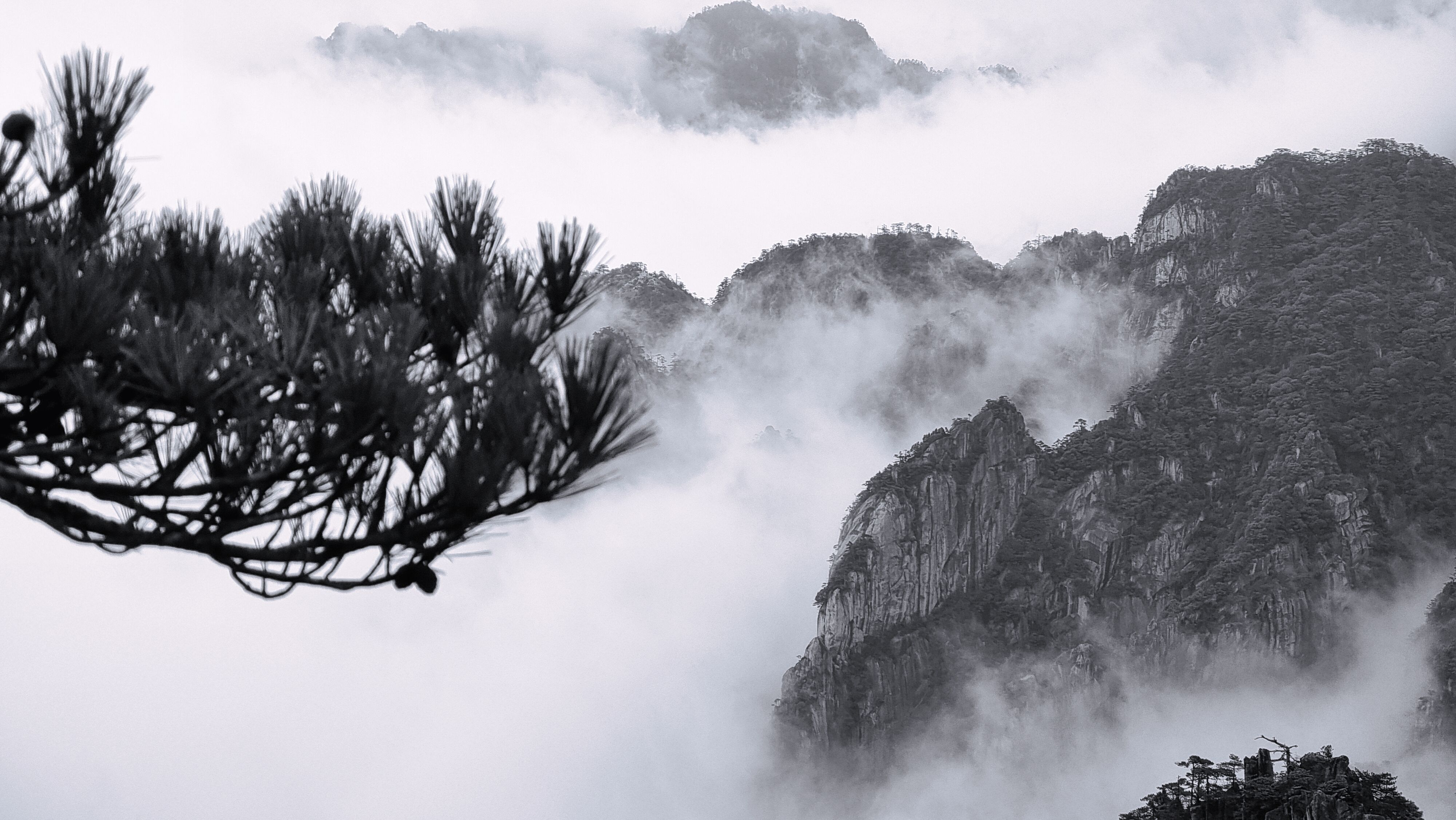
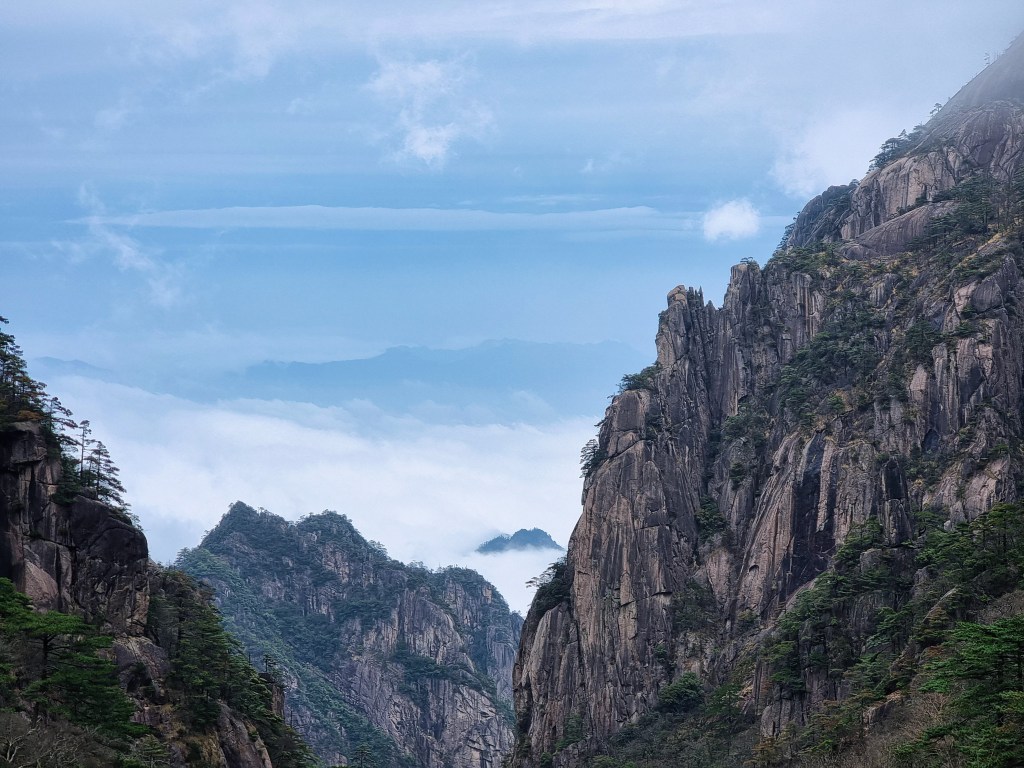
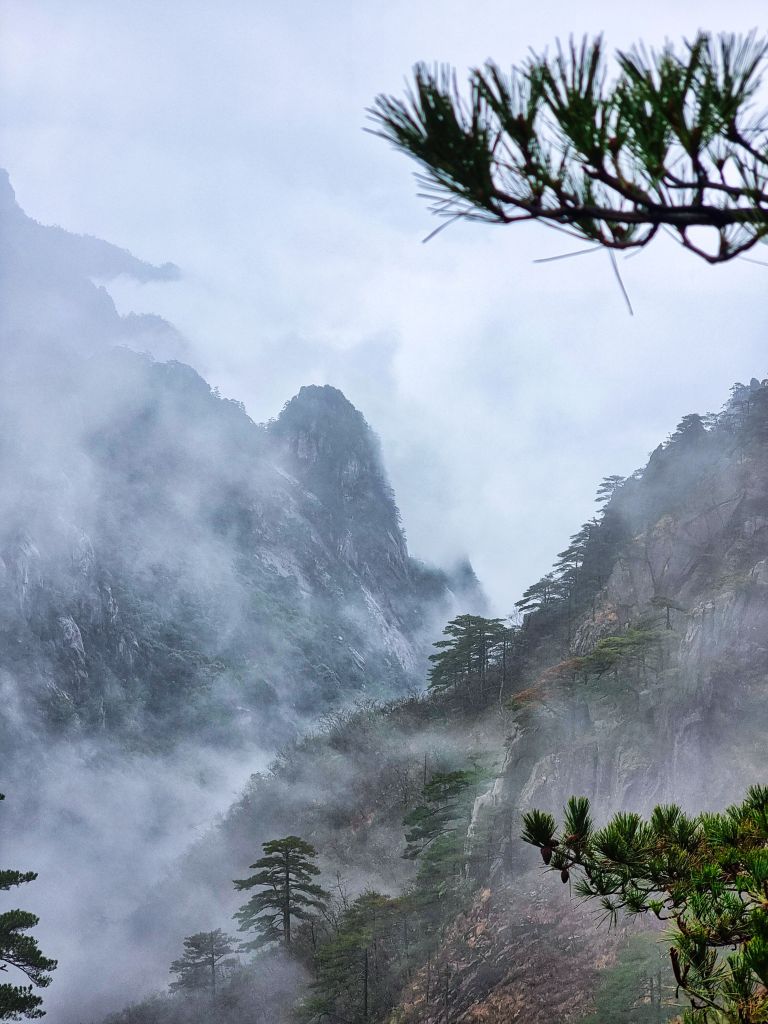
Enshrouded in fog and clouds, the granite peaks of Huangshan (黄山) are the perfect antidote to the hustle and bustle of China’s metropolis. The fantastic mountainscape gives the impression of a traditional ink-wash painting, inspiring painters and poets for centuries.
“Normally, you would see the peaks from here!”, my guide, Jessica, said as we sat in the cable car heading to Huangshan’s summit. There was nothing around us, except a thick blanket of clouds – a total whiteout. This phenomenon is common, because the area receives plenty of rainfall, up to 300 days a year. Clouds are, therefore, an essential part of Huangshan. And the mountain range is renowned for its stunning scenery which features a jumble of sheer granite cliffs emerging through a perpetual sea of clouds.
In fact, these fantastic vistas have been immortalized in Chinese art since as early as the Tang Dynasty (618 – 907). It inspired an entire school of painting – the shui mo style, which depicts landscapes using shades of black ink. Not only painters were attracted to Huangshan, but writers also held these mountains in high esteem. Most famous was the poet Li Bai who coined this mountain range “Huangshan” in honor of Huangdi – a legendary emperor of ancient China who discovered the elixir of immortality and ascended to heaven from these cloud-shrouded peaks.


Hiking through the Clouds
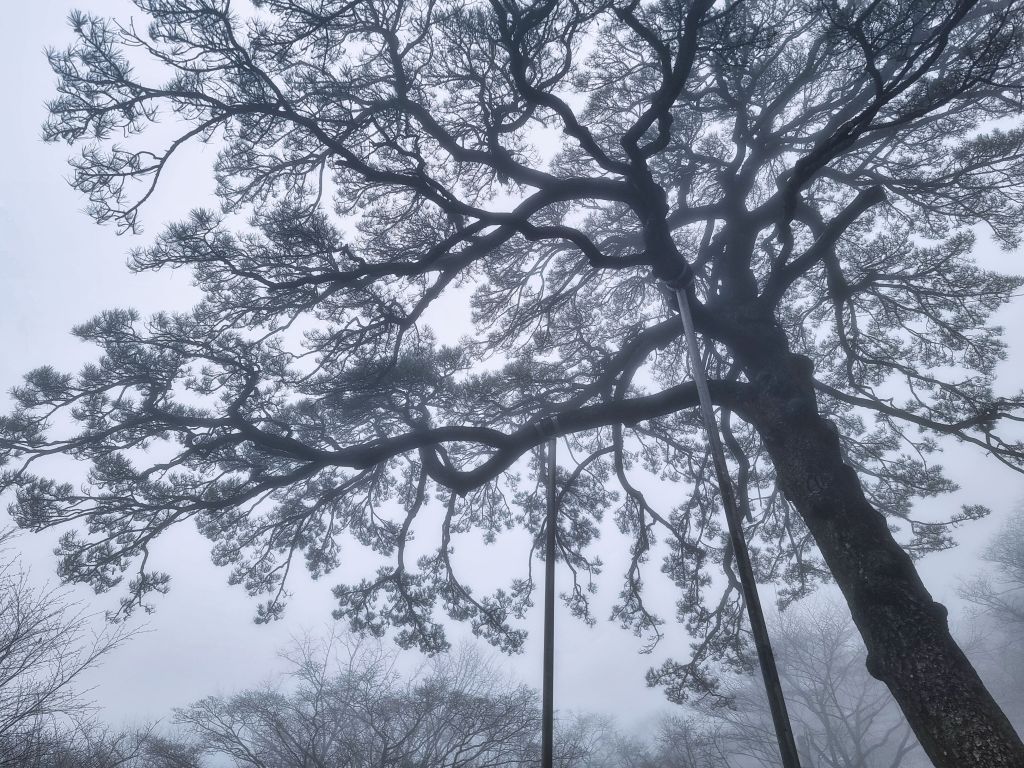
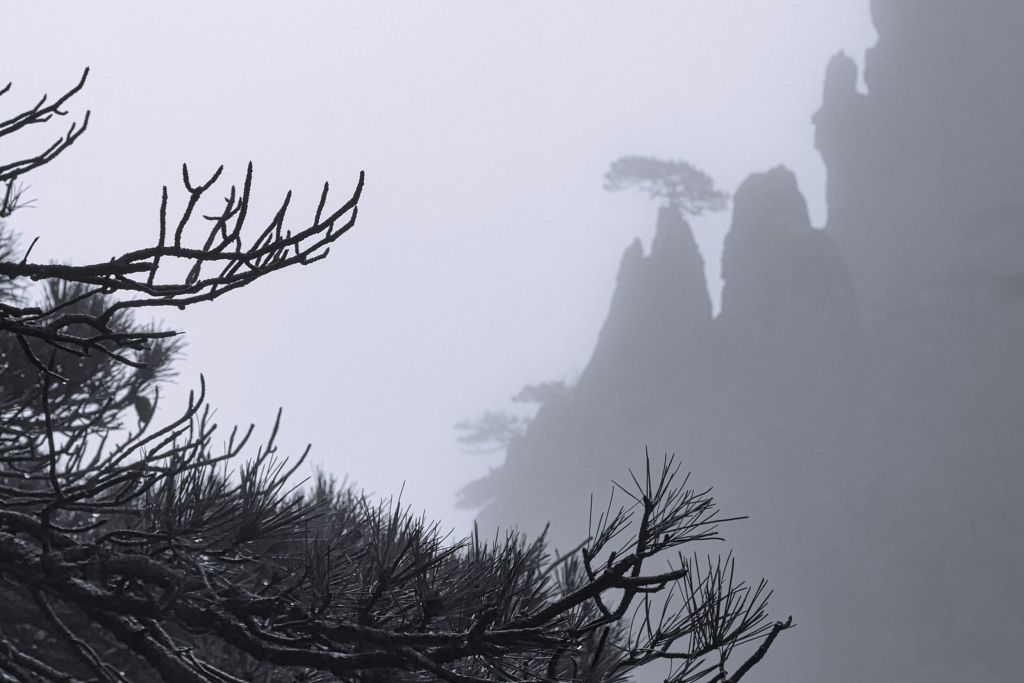
The mountaintop was smothered in clouds. It was so dense that I could only recognize the silhouette of ancient pine trees. They are endemic to Huangshan and grow straight from the hard rock face – fine examples of nature’s vigor and vitality. These trees vary greatly in shape and size, featuring gnarled and asymmetrical branches. Many are hundreds of years old and have been given names. For instance, the Yingkesong, or Guest Greeting Pine, is thought to be more than 1500 years old. Beyond those weathered pines are, however, an empty void.
Huangshan was preparing something special behind a curtain of white. I could feel it as we hiked through the clouds, meandering up, down, and across the peaks. After many flights of stairs and narrow steps chiseled into boulders, we arrived at Xihai Grand Canyon – one of the most scenic parts of Huangshan. Visibility was still low, but the dark green of pine trees and sand yellow of cliffs popped through the misty veil. At some points, I could also see rocks in peculiar shapes that seemed to be works of carving. But the imposing landscape was nowhere in sight.


The Ephemeral Beauty of Huangshan
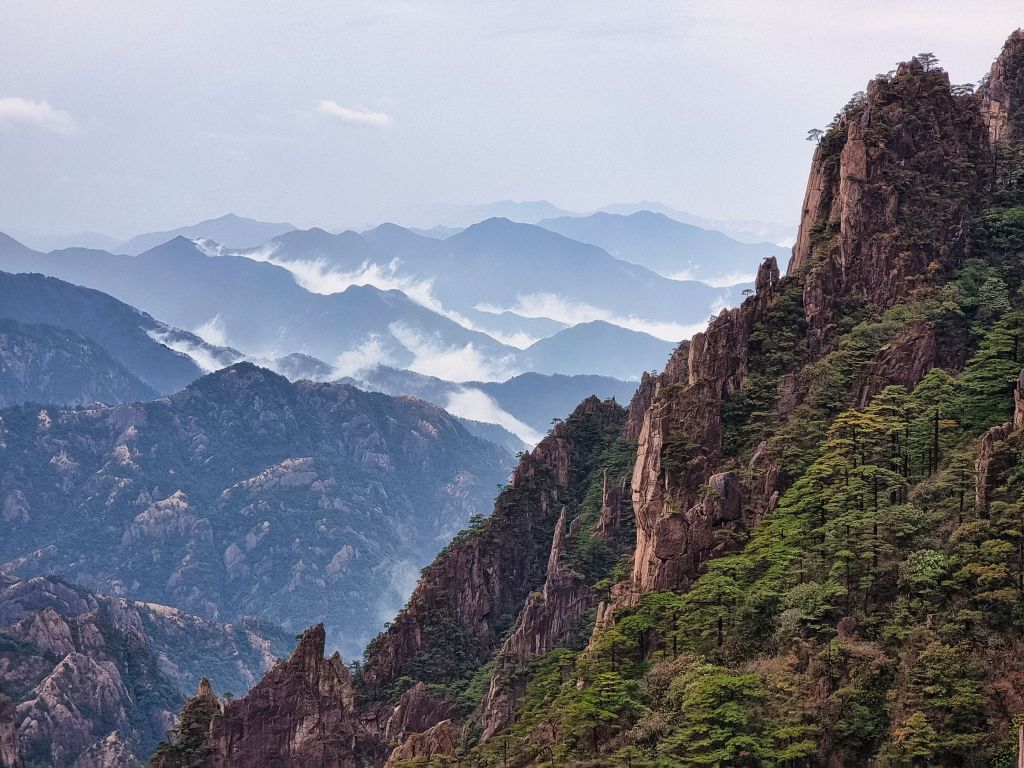
“What was shrouded in the fog yesterday would be visible by now.”, Jessica assured me as we returned to the hiking trail the next morning. Indeed, the strong gust in the evening partially dispersed the clouds, revealing a spectacular landscape that seemed to be plucked out from a traditional ink-wash painting. The bright clouds accentuated the peculiar shapes of jagged pinnacles, cloaking them in mystery. I thought to myself that I could watch this scene forever.
But nature is constantly changing and its beauty is often fleeting. After the morning spectacle, clouds and fog swirled again around the soaring peaks. They then raced through the canyons, drifting like giant hot-air balloons across the landscape and swallowing everything. I stood there speechless, thinking I was seeing a mirage called Huangshan. Because at the same spot just moments ago, there was a massif consisting of monumental peaks.


How to get to Huangshan
- Located in Anhui Province, Huangshan is easily accessible by bullet trains (G-type) from major cities, including Hangzhou (90 minutes), Shanghai (2.5 hours), or even Xiamen (4.5 hours). The train stops at Huangshan North Station (黄山站), which is about 20 kilometers from Huangshan City.
- The journey to the mountains is slightly more tricky, including two transfers. First, you have to take a taxi or bus to Tangkou, the southern entrance of the Huangshan Scenic Area (no private car is allowed to pass this point). Then, a shuttle bus will bring you to the cable car station (halfway to the summit). The bus trip takes about 20 to 30 minutes. Finally, ride the cable car to the summit, which takes approximately 15 minutes. Tickets for each section are sold separately. Please note that the cable only operates from 7:00 to 16:00.
Practical Information
- From the cable car station, there is a network of trails spreading in various directions. They are well-paved and equipped with stable handrails. However, there are a lot of steps. Some parts are steep and narrow, and thus require a little patience when it’s crowded.
- Walking sticks and grip shoes are a must. A waterproof jacket is highly recommended because the weather changes quickly. It’s influenced by the clouds and winds that sometimes blow at impressive speeds between the rocky peaks.
- It’s advised to stay overnight on the mountaintop. This way, you can enjoy the sceneries without the horde of day trippers that arrive en mass at 9:00 and leave before 16:00. Another advantage is that you can enjoy the sunrise or sunset above an ocean of clouds if the weather is good. There are accommodations for every budget, ranging from dormitories, and hostels to hotels. However, selection is limited.
- In case, you cannot hike anymore. There are sedan services (palanquin) that can bring you to the destination. However, it’s expensive and comfort is questionable.
- Surrounding Huangshan are several villages that have faithfully preserved the architectural style, the urban layout, and other intangible heritage elements of a cultural region once known as Huizhou.


So beautiful, in the most it looked mysterious and had its own beauty , but when the clouds lifted, wow. Such beautiful scenery emerged. Maggie
It was fascinating! Exactly like a painting. Thanks for the kind words, Maggie 🙂
Lần nào nhìn hình và đọc bài của LEN tim tớ cũng đập nhanh hơn, thật luôn :)))
Lần trước tớ đi Lệ Giang, gặp một nhóm bạn người Trung Quốc đến từ Hoàng Sơn, bạn đó hình như cũng có kinh doanh homestay ở chân núi. Bạn lúc nào cũng treo ở miệng câu: “Mày phải đến Hoàng Sơn, nó có cảm giác tiêu diêu, vẻ đẹp vượt xa những gì mày có thể tưởng tượng”. Ừ, giờ công nhận rồi.
Lúc đầu mình cũng nghĩ giống bạn. Nghĩ là mấy pháp sư Trung Hoa chắc chỉnh ảnh nên ảo. Cùng lắm thì cũng như mấy dãy núi phía Bắc của mình thôi 🙂
Nhưng không, Hoàng Sơn ảo thật. Nó không cao như nhiều núi khác, nhưng cảnh thì đúng như tranh thủy mặc.
Hướng dẫn viên của mình còn giải thích cảnh ở đây đặc biệt là do ba thứ: mây, gió và cây tùng. Chứ nếu mà đi vào ngày trời trong thì chỉ thấy cảnh núi đá khô khốc. Chẳng thi vị gì 🙂
What a mysterious landscape with the clouds and mist. Just magical!
Thanks, Anna! Though I couldn’t see sunrise or sunset above the clouds, I was still stunned by the mist-covered landscape.
Now I can see where the ancient Chinese painters got their inspiration from to create images of mountain peaks shrouded in clouds using only black ink. To me, those paintings are very elegant. How nice that you’ve got to see this place in person!
Thanks, Bama 🙂 I’m also a fan of ink-wash paintings. I like how the artists stripped all colors to express the main features of the landscape. Elegant and somewhat minimalist!
I guess the people who invented ink-wash paintings also came to Huangshan on a very foggy day. And they couldn’t see anything except the dark hues of pine trees and rocks 🙂
It feels eerie, and mystical. I think you really captured the ephemeral beauty of this place; and I can see why it inspired those beautiful paintings.
Alison
Beautiful trail, and so beautifully written. <3
Thanks for the kind words, Rama 🙂
Simply amazing and your stunning images tell a wonderful story, Len.
I’m glad that you like the post, Jane 🙂 Thank you!