
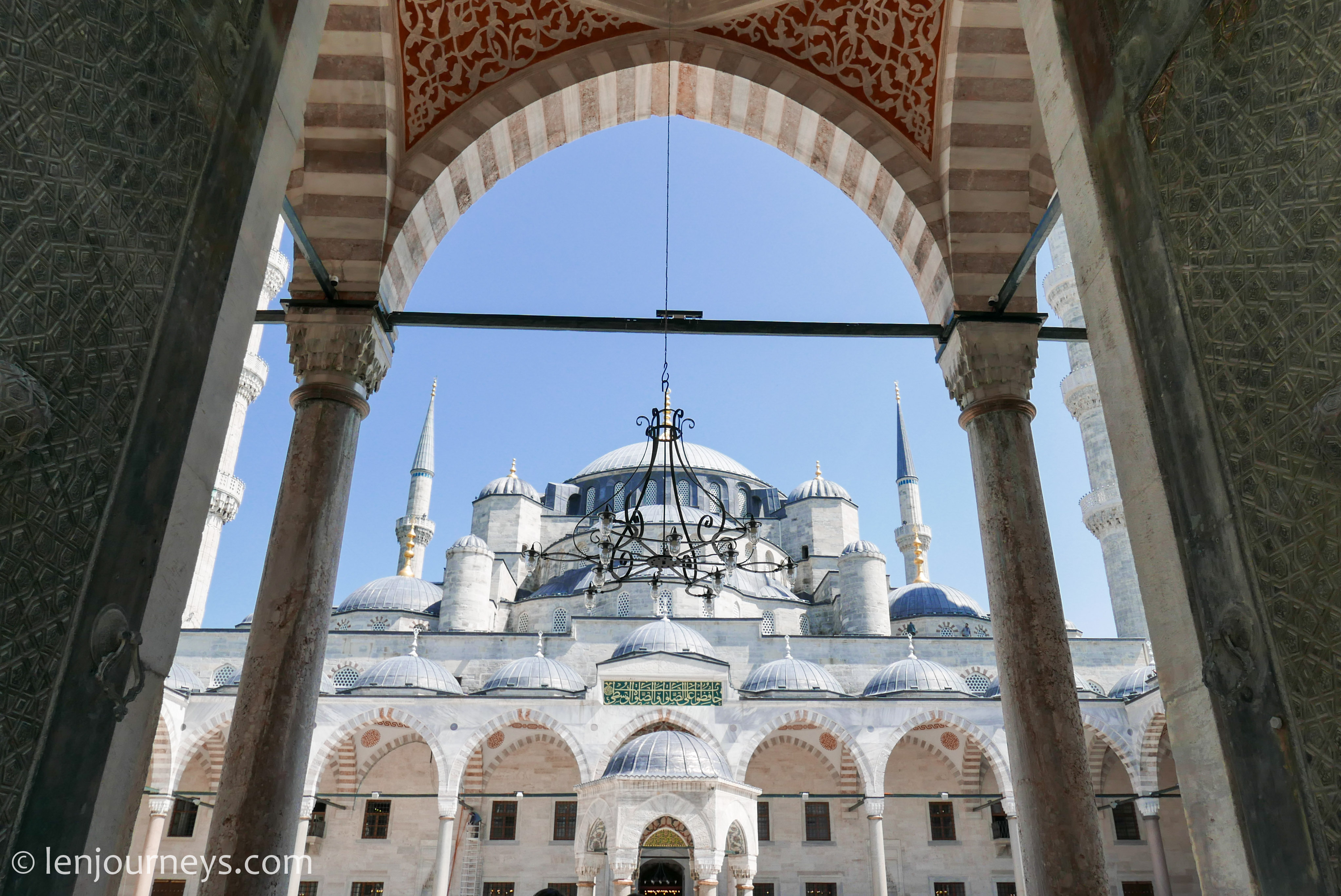
Following the conquest of Constantinople, the Ottoman sultans poured a considerable fortune into restoring and revitalizing the new capital city, Istanbul. They wanted to make it the empire’s crown, adorned with opulent palaces, magnificent mosques, and intriguing bazaars that surpassed any of its predecessors.
Hours after the fall of Constantinople, Sultan Mehmed II declared himself as Kayser-i Rûm, the Turkish equivalent of the Caesar of Rome. Constantinople, of course, became the new imperial capital, with its official name changed to Kostantiniyye. Yet it was commonly known as Istanbul, which stems from the Greek phrase “στην Πόλι” (stin polis), meaning “in the city”.
A vast building program soon followed, turning the ruinous old town into a fabulously wealthy metropolis. Redevelopment took place everywhere, from roads and aqueducts to the defensive walls. Bathhouses, mosques, pavilions, and walkways were built, along with a new covered market at the heart of the city (which still stands today as the Grand Bazaar). Sultan Mehmed II also commissioned a magnificent royal residence to rival, if not overshadow the European counterparts, the Topkapi Palace.
A fabulously wealthy imperial capital.
Istanbul’s revitalization reached its zenith under the reign of Sultan Süleiman the Magnificent, whose sobriquet alone captured the spirit and affluence of the time. New districts were developed, featuring elaborate mosques and civil infrastructures, such as bridges, aqueducts, hospitals, and warehouses. The city continuously grew in the subsequent centuries, with splendid mansions sprung up like a string of pearls on the shore of the Bosporus. They are grand, marbled, gilded, and often lavishly embellished inside and out.


Brief History of the Ottoman Empire
The Ottoman Empire was founded at the end of the 13th century by Osman I – a nomadic Turkic tribal leader from northwestern Anatolia – who conquered Asia Minor through both warfare and diplomacy. Decades later, his descendants swarmed across the Bosporus and delivered crushing defeats on the Byzantines, the Bulgarians, and the Serbs, cementing the Ottomans’ foothold in Europe. Then, in 1453, Constantinople – the last Byzantine stronghold – was brought to its knees thanks to advanced weapons and the strategic mind of Mehmed II.
Commanding the crossroads between East and West, the Ottoman Empire was one of history’s most powerful empires.
With Istanbul as its capital, the Ottoman Empire now became an economic powerhouse, controlling some of the world’s most lucrative trade routes. Meanwhile, its impeccably organized military led to successes on the battlefields. The empire continued to expand deep into the Balkans, the Middle East, the Caucasus, and North Africa. They even locked horns with Safavid Persians in a series of wars. The 16th century was the Golden Age of the Ottoman Empire as governmental and social systems reached the highest development, art flourished, and there were major breakthroughs in science, medicine, and architecture.
However, things started to go south by the late 17th century as a result of political infightings and the opening of new trade routes. Without the ever-growing fund, territorial expansions became difficult, creating a vicious cycle that further destabilized the empire. At the same time, the rise of European powers, first with the Renaissance and then the dawn of the Industrial Revolution, weakened the once peerless empire, resulting in the loss of key regions. The catastrophic defeat in World War I was the final nail in the coffin of the Ottoman Empire. After 600 years, the sultanate was abolished in 1922 and replaced by the republic headed by Turkish nationalist Mustafa Kemal Atatürk – the founder of modern-day Turkey.
1. Topkapi Palace
If Istanbul is deemed the empire’s crown, the Topkapi Palace – which stands atop a hill overlooking the Golden Horn, the Bosporus, and the Sea of Marmara – will be the jewel in that crown. The majestic complex was the imperial residence of the Ottoman sultans and their families for nearly four centuries. It also served as the seat of government and a center of education and culture. In short, it’s the heart of the mighty Ottoman Empire.
Yet unlike the European palaces, which feature one large building surrounded by gardens, the Topkapi consists of a series of pavilions that are arranged into four vast courtyards. It evokes the image of tented encampments from which the nomadic Ottomans had emerged, albeit much more opulent. Each pavilion has a different function, such as the cooking quarter, the treasury, the barrack, the audience chamber, and even the mosque. It’s like a city within a city. Interestingly, the palace didn’t have a strict master plan and the sultans could expand and alter various parts over time.
A symbol of wealth and power, Topkapi Palace was embellished by the most experienced artisans and with the finest materials of that time. Think of pristine white marble fountains, stained glasses, marvelous Iznik tiles, intricately painted ceilings, exquisite rugs, and mother-of-pearl inlays. Certainly, no expense was spared in this architectural gem. Adding to that are incredible collections of porcelains, weapons, jewelry, and even sacred relics. Each object is unique and displays a remarkable level of craftsmanship.
Topkapi Palace is a symbol of splendor.


Tips: It’s recommended to enter the First Courtyard from the side gate (near the Archaeological Museum) as the queue for security check is often shorter than at the Imperial Gate. The ticket office stands in this area.
Harem
The splendor reaches its peak in the harem – the living quarters of the imperial family. Every single detail was meticulously crafted, from swathes of beautiful Iznik tiles, and patterns in gold leaf, to gilded inscriptions from the Quran. The decoration is particularly lavish in the Baroque-styled Imperial Hall where the sultan held audiences. It’s virtually covered in gold and hand-drawn floral paintings. Aside from being a symbol of opulence, the harem reflects the changes in Ottoman’s palace architecture from the 16th to the early 19th century.
Contrary to popular belief, the harem wasn’t always a place where the sultan could engage in debauchery. It’s practically an enclosed residential area where the sultan lived with female family members such as his mother, consorts, and underage children. Everything in this complex was governed by strict regulations and etiquette, and the sultana (or chief consort) was the overseer. At its greatest extent, the harem had over 300 rooms spreading over six floors. They have various functions, from kitchens, dormitories, schools, and bathhouses to clinics.
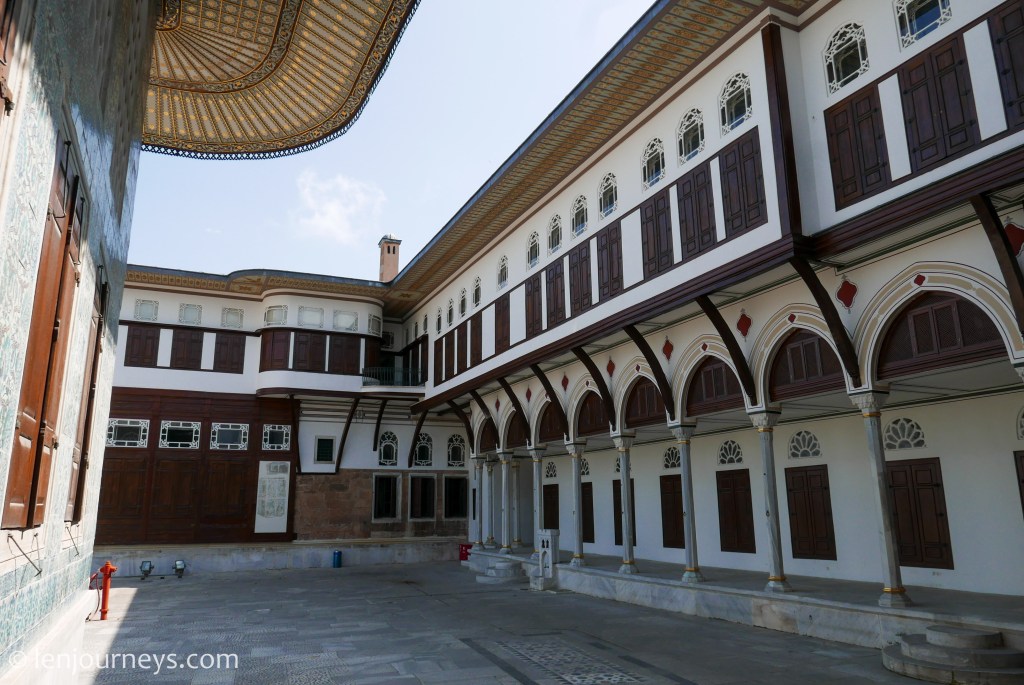
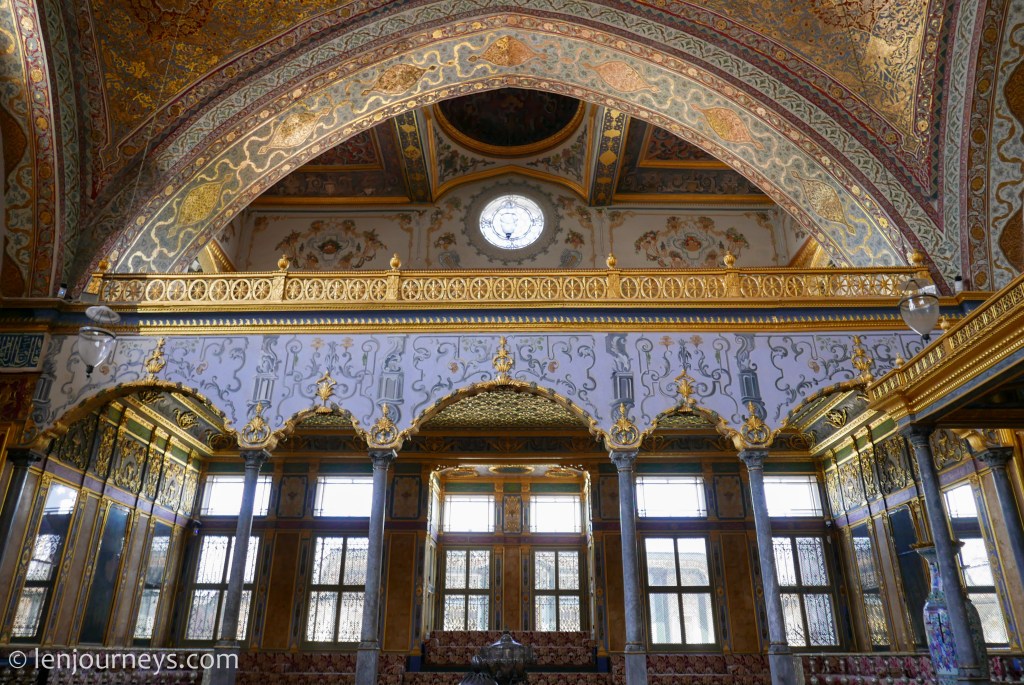


Tips: The harem is definitely worth a visit as it provides a glimpse into the private life of the Ottoman sultans. Yet an extra ticket is required (purchasable in the Second Courtyard). If you intend to explore this quarter, consider buying the combi ticket. It’s cheaper than getting two tickets separately. The entrance to the harem is located under the Tower of Justice.
2. Blue Mosque
A short walking distance from the Topkapi Palace is the magnum opus of Ottoman religious architecture, the Blue Mosque. Constructed under the reign of Sultan Ahmed I in the late 17th century, the mosque’s official name is Sultan Ahmed Mosque. However, it’s best known for its awe-inspiring interior adorned with more than 20,000 pieces of brilliant blue, green, and turquoise Iznik tiles; hence the sobriquet. The theme is Gardens of Paradise, using traditional floral motifs such as tulips, roses, carnations, and lilies. Their beauty is accentuated by the natural light that pours into the building from 260 stained glass windows. The abundance of light and the vivid colors evoke visions of heaven, attracting people to the mosque.
Outside, the Blue Mosque impressed visitors with its wonderfully curvaceous appearance. It features a cascade of blue-painted domes over a large unified prayer hall. In front of this is a proportionally grand courtyard framed by a domed arcade on all sides, except for the prayer hall entrance where the arches expand. Another staggering characteristic of the Blue Mosque is the six slender minarets, unlike the usual two or four of most imperial mosques. According to local legend, they were built by mistake. Yet it still caused outrage among the public because it implied equality with the Great Mosque of Mecca (which had six minarets at the time). The sultan solved this issue by adding a seventh minaret to the one in Mecca.


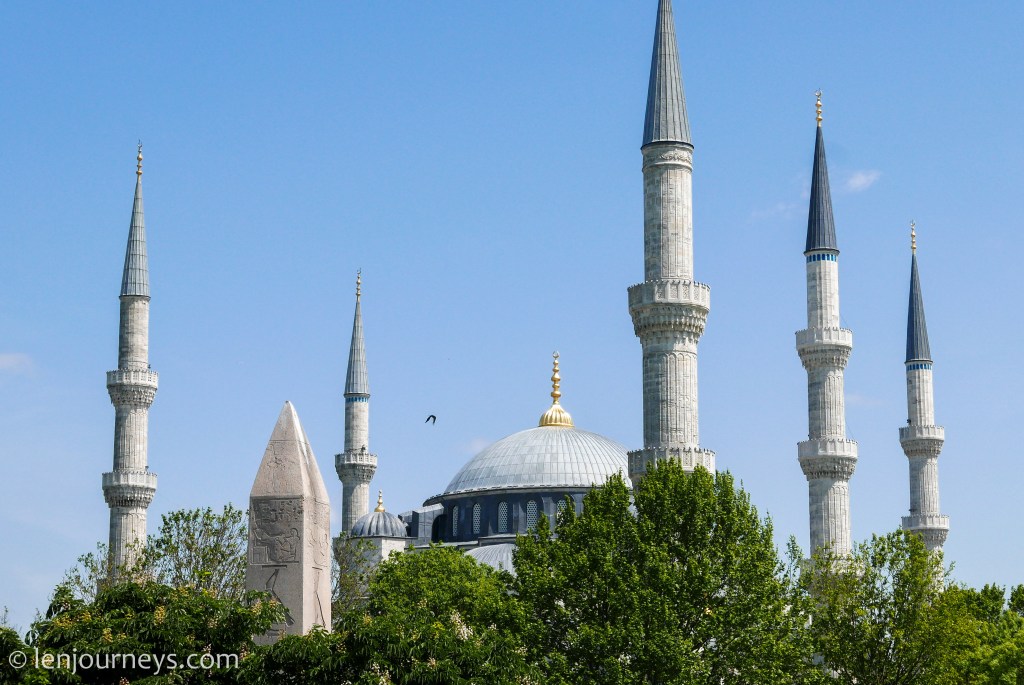


Tips: To best grasp the grandeur and the perfect proportion of the Blue Mosque, enter the complex via the Hippodrome rather than from Sultanahmet Park. Please note that the building is closed to non-Muslims during the five daily prayer times.
3. The Bazaars
Chaotic and colorful, the Grand Bazaar is Istanbul’s beating heart and has been so since the late 15th century. It’s like a vast roofed maze flanked by thousands of old neighboring shops that sell virtually everything. From glass lamps in every colorway, hand-knotted rugs, and goldware, to antiques, one is spoilt for choice here. Meanwhile, a trip to the Spice Bazaar is a sensory experience. It’s fragrant and vibrant with heaps of bright spices, aromatic herbs, teas, and a myriad of lokum (Turkish delights).
Hidden among the narrow lanes of the bazaars are han – historic inns where merchants could rest after an arduous journey to Istanbul, often from as far as Persia, India, and China. Though today many are in poor shape, they retain some of their original architecture, including the arched corridors, doors, and windows, as well as the dome-shaped ceilings. Together with the bazaars, the han gives us an idea of how trade and commerce were conducted during the Ottoman era.


Istanbul still is one of my favorite cities on the planet. It has a rich history, great architectural marvels, magnificent natural setting, as well as the flair of a major European city. It’s nice to ‘revisit’ it through your beautiful photos. Judging from the intensity of the sun light, I guess you went in late spring/early summer?
Yes, I was there in late May. Though it looked sunny, it was quite cold, especially at night. I also like Istanbul, but some parts are even more chaotic than Saigon. I couldn’t see the flow of traffic at all. Really glad to see your comment, Bama 🙂 Hope you are feeling better now.
Such beautiful photos… a place i dream of visiting!
Thanks, Anna! Istanbul is indeed amazing. Somewhat chaotic, but I guess it was the characteristic of this crossroad between East and West.
What a wonderful detailed post, with gorgeous photos. It brought back many memories for me. We loved Istanbul, and visited all of these places. Such a rich history here.
Alison
Thanks for the kind words, Alison 🙂 Just read about your adventure in Africa. Fascinating!