

While most people come to Laos for Luang Prabang’s exquisite temples or the natural landscape of the far south, the capital, Vientiane, is often seen as little more than a pit stop on the way in and out. That needs a rethink. With its Buddhist heritage and raffish charm, this city is a worthwhile addition to any voyage through Laos.
Life moves more slowly in Vientiane. That’s what I perceived when visiting the Laotian capital. The contrasts to neighbouring Southeast Asian capitals like Hanoi or Bangkok could hardly be starker, with light traffic on the wide boulevards, soft-spoken locals and a compact, walkable downtown. There is none of the frantic hustle, none of the begging, touting or sycophany that plague other tourist hubs. Instead, there is a laid-back vibe that has gradually become the city’s trademark.
Indeed, this city on the banks of the Mekong River doesn’t rush its visitors through a checklist of attractions. Quite the contrary, it offers them a chance to slow down and tell its history in a typically relaxing way. From the golden stupa of That Luang and the monumental Patuxai to other Buddhist temples, travellers can explore them at their leisure. On the way, they can stop by many still-standing colonial mansions — some of which are lovingly transformed into trendy shops, cafes, or restaurants.
Brief History of Vientiane
A turbulent history hidden beneath the peaceful appearance.
Despite its mellow appearance, Vientiane has a turbulent history. It originated as an 8th-century Dvaravati polity situated just northeast of the Mekong River. The city then became a vassal state of the Khmer Empire before being overwhelmed by Laotian settlers from southern China in the 11th and 12th centuries. Over the ensuing two centuries, Vientiane grew into a commercial and administrative center of the Lan Xang Kingdom, albeit not its capital. That status changed in the 1560s when King Setthathirath relocated his court here from Luang Prabang.
Following the collapse of the Lan Xang Kingdom in the early 18th century, Vientiane once again became an independent city-state. Yet its independence didn’t last long, as Siam soon took over. Vientiane was spared destruction, but many of its treasures were looted, including the revered Emerald Buddha and other important Buddha images. The doom, however, came in 1828, following the failed rebellion led by King Anouvong of Vientiane. The entire city was razed to the ground by the Siamese army and only recovered after the establishment of the French Protectorate in the late 19th century. The collection of colonial architecture, monuments, and boulevards in today’s Vientiane dates to this period.
By the mid-20th century, stability in Vientiane was simply out of reach due to World War II and later the American War in Indochina. Things only began to settle down with the Pathet Lao’s victory at the end of 1975. Since then, the city has steadily developed as a laid-back capital of Laos. And while it can hardly compete with the former royal capital for good looks, it has a raffish charm of its own.
1. Pha That Luang
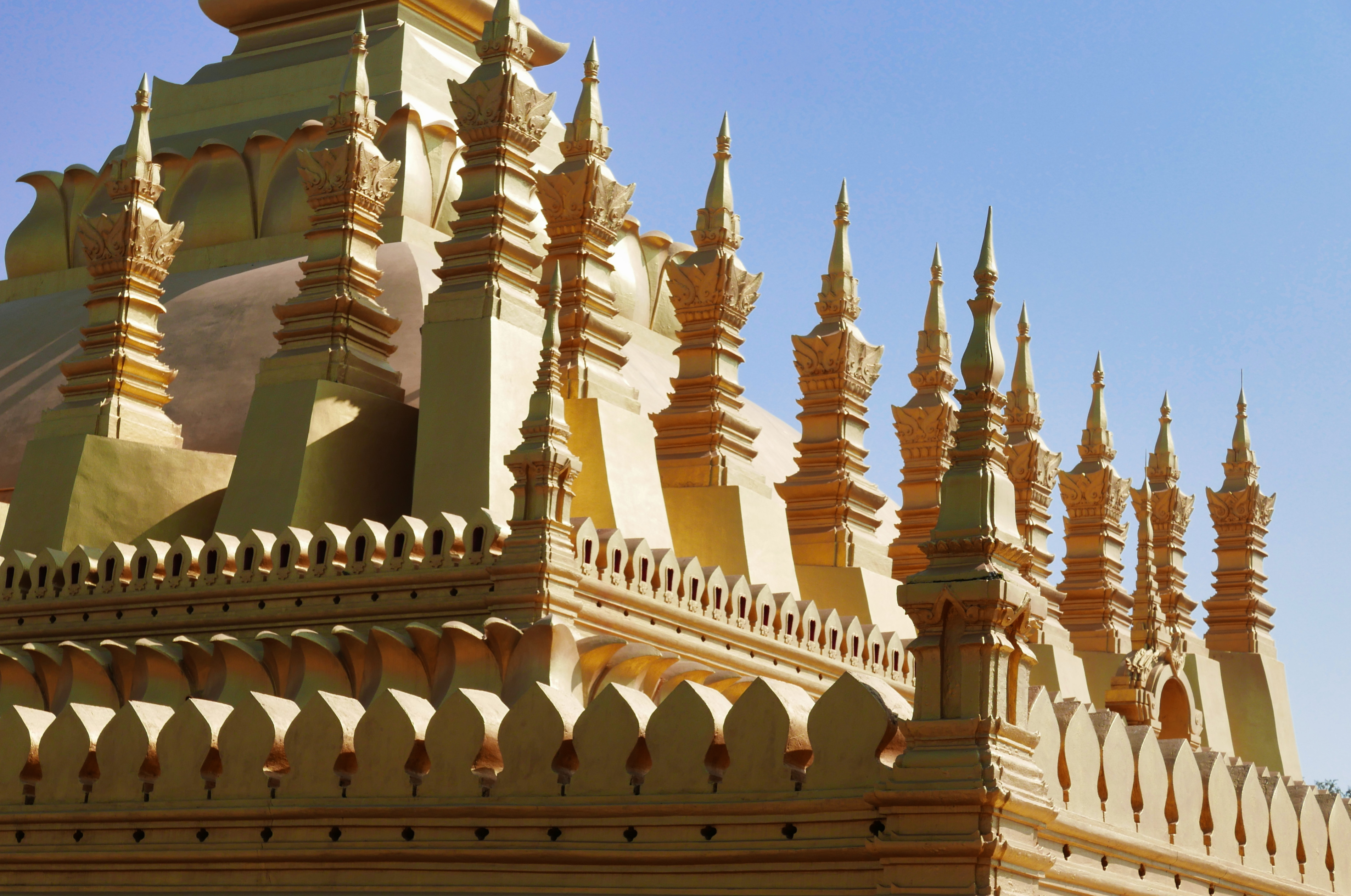
Right after the capital was moved, King Setthathirath of Lan Xang carried out a construction campaign in Vientiane. New temples and palaces were built, while the city’s defense system was strengthened. Pha That Luang – then a Khmer temple ruin – also underwent a massive reconstruction. It was designed like a big pyramid with a gourd-shaped spire reaching 45 meters in height. The structure then rests on a square base enclosed by a two-tiered wall decorated with stylized lotus petals and around thirty intricate miniature stupas atop. All was covered in shimmering gold leaf and guarded by nagas on four sides.
What we see today, however, is an extensive reconstruction dating to the French colonial period. The original stupa was burnt down, along with the entire city, during the Siamese invasion in 1828. Its contents, reportedly including Buddha relics and many precious jewels, were also looted. Even so, the temple stands as the most significant monument in Vientiane and a national symbol, reflecting Lao culture and identity. In addition to the gilded stupa, Pha That Luang features a cloister that has now been turned into a gallery, where numerous Lao- and Khmer-style Buddha statues and artifacts excavated throughout the city are on display.



2. Haw Phra Kaew
Also constructed during the 1560s building campaign was Haw Phra Kaew – once home to the sacred Emerald Buddha (now in Bangkok). It was erected within the grounds of the former palace as the private chapel of King Setthathirath and the royal family. However, like the rest of Vientiane, it suffered destruction following the Siamese attacks. The chapel was rebuilt under the French colonial regime, yet it resembles more of a 19th-century Bangkok-style ordination hall than a Laotian temple. Only the ornate wooden door is from the original chapel.
Today, Haw Phra Kaew functions as a great museum of Lao religious art. Exquisite Buddha statues of various materials and forms are displayed outside and inside the former chapel. Most are antique, dating back as far as the 6th century. There are also Buddha images and Buddhist texts written on palm leaves, as well as the gilded throne for the looted Emerald Buddha statue. The building itself is no less impressive, furnished with crimson red and intricate gilded carvings throughout.


3. Wat Si Saket
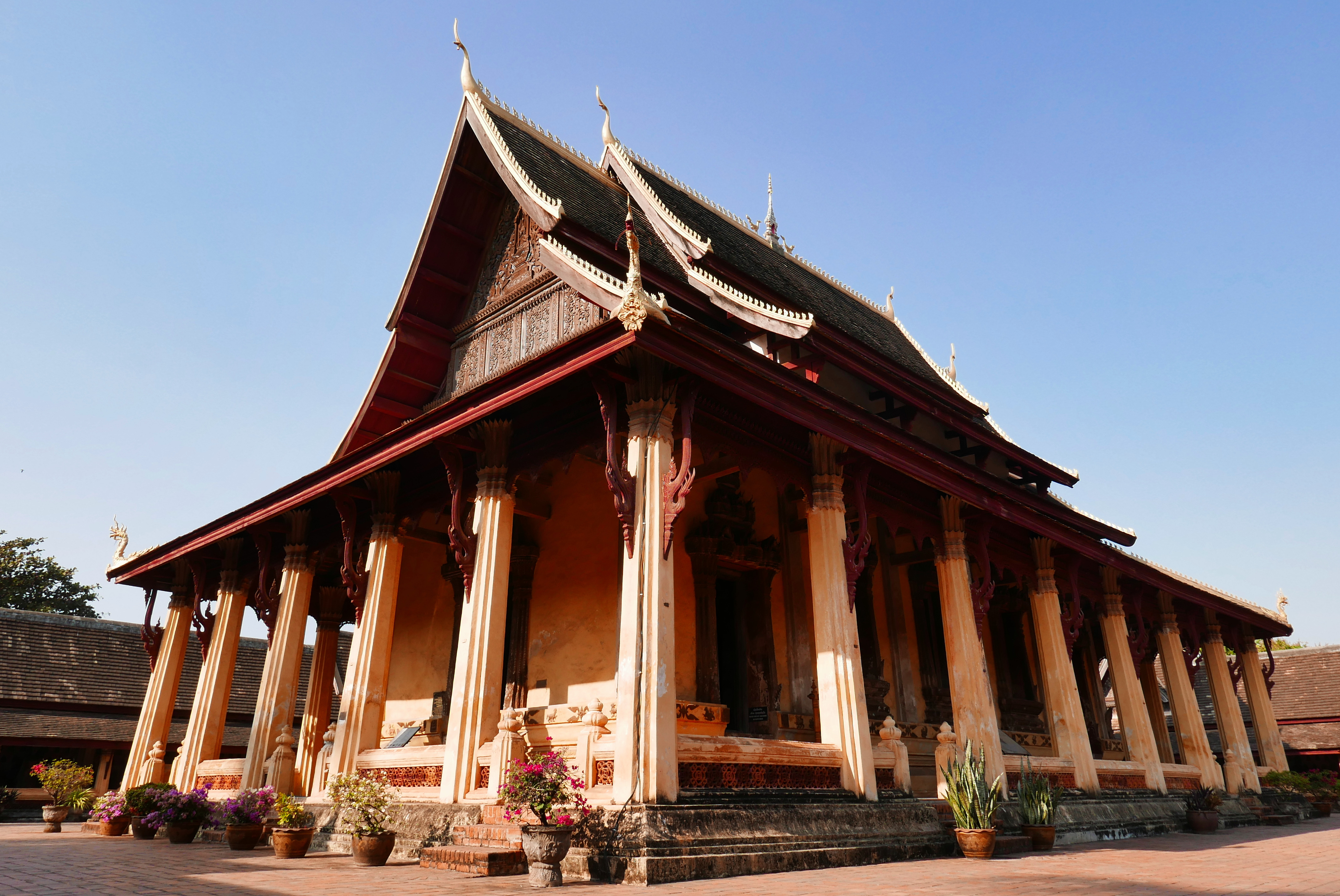
Across the street from Haw Phra Kaew is Wat Si Saket – the only temple in Vientiane that survived the Siamese invasion of 1828. Legend tells that a frightening thundercloud rolled across the sky when Siamese troops intended to attack the temple. Interpreting this as divine wrath, they halted the attack, sparing the temple. A more realistic explanation for stopping the attack is that this temple had a Bangkok-style architecture, featuring a five-tiered gable roof and a cloister surrounding the ordination hall. Destroying this would be blasphemy, so the Siamese army used the compound as their headquarters and lodging. Whatever the reasons, Wat Si Saket stands today as a symbol of Vientiane’s resilience and its most beautiful Buddhist temple.
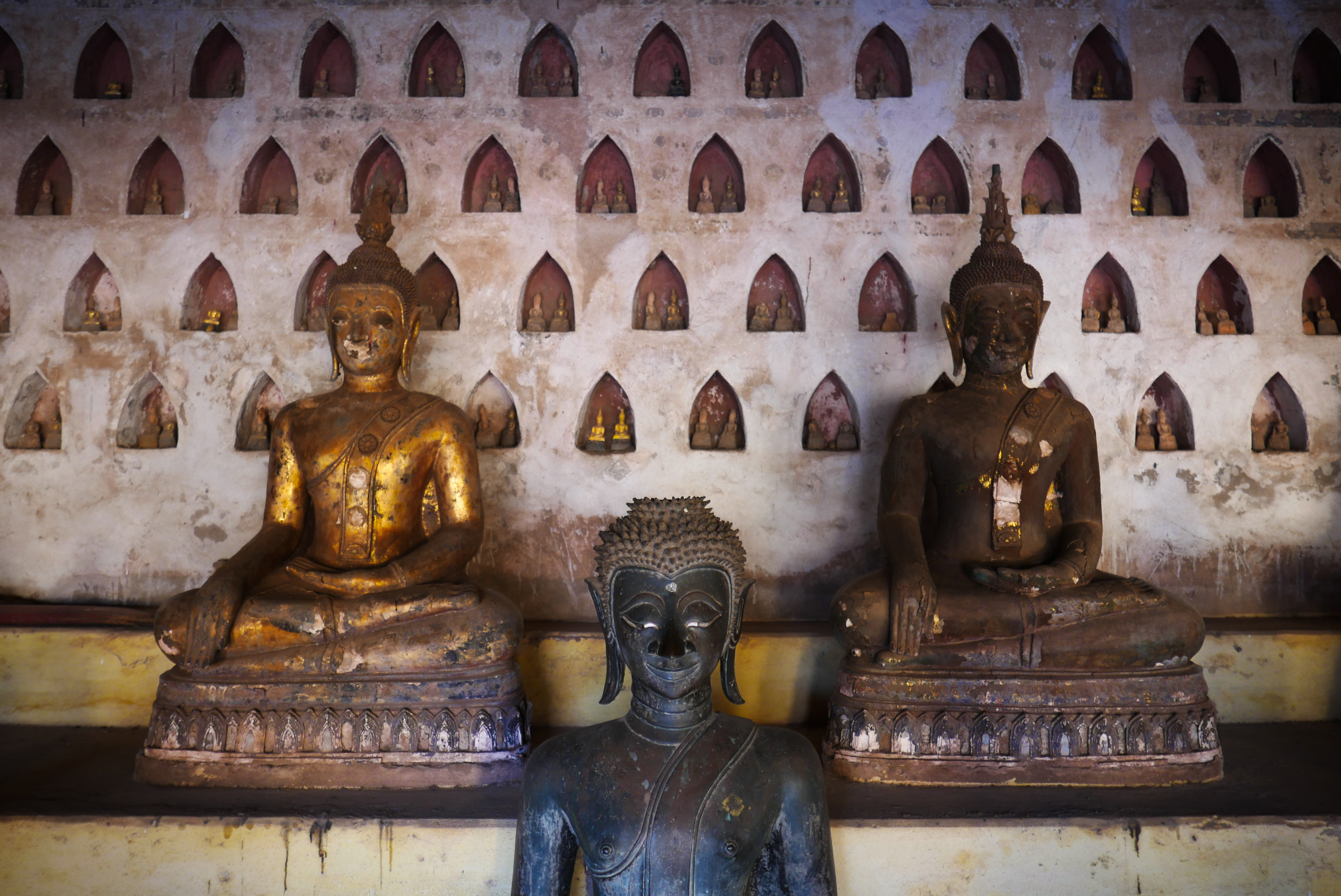
Originally built in 1818 by King Anouvong, Wat Si Saket was a venue for the taking-of-oath ceremony by Laotian nobles. It’s best known for its extraordinary collection of nearly 7,000 Buddha statues crafted between the 16th and 19th centuries. Most are tiny and placed in thousands of petal-shaped niches throughout the temple, while around 300 larger Buddha images are arranged along the corridor. In addition to the statues, Wat Si Saket houses many valuable books, paintings, and ancient manuscripts, as well as a vivid mural depicting the life of a Buddha’s incarnation inside the main hall.


4. Patuxai
Standing tall at the heart of Vientiane, Patuxai is a memorial gateway built to commemorate Laos’ independence from France and earlier occupiers. The victory monument was constructed in 1957 by the now-abolished monarchy, using funds and cement that had been initially intended for a new US military airbase. It took eleven years to complete and has now become an icon of Laotian capital.
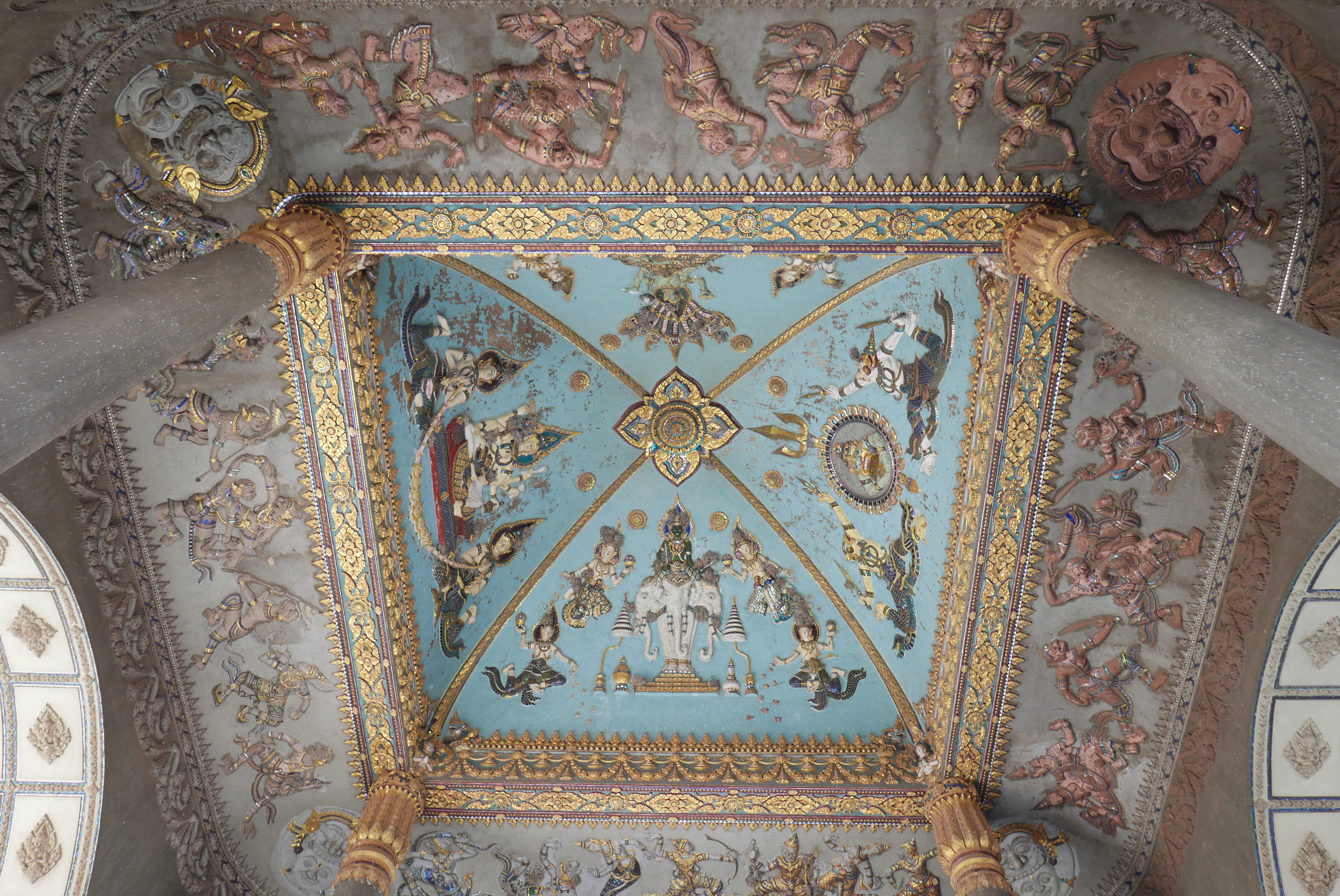
From a distance, Patuxai reminds many travellers of the Parisian Arc de Triomphe. But a closer look reveals Laotian elements cleverly fused into this Western-style structure. The monument has four towering arched doorways and a sky-blue ceiling, both richly adorned with deities and mythical creatures in Lao culture. Meanwhile, the upper floor consists of five ornate towers topped with elaborate gilded spires.



Tips for Visiting Vientiane
- Travelling around Vientiane is fairly easy with tuk-tuks and ride-hailing services. Walking is also possible in the downtown area.
- The inner part of Pha That Luang is off-limits to visitors. It’s only open to monks conducting ceremonies. Nevertheless, visitors can pay homage to Lord Buddha in one of the four pavilions placed at the center of each side.
- Photography is not allowed inside the main hall of either the Haw Phra Kaew or the Wat Si Saket.
- During the day, visitors can enter the Patuxai for a small fee. They will walk through the museum first before ascending the roof and taking in the view of the central boulevard.


This brings back a lot of good memories from my relaxing trip to Laos back in 2012. It’s good to know that the weather was really nice when you went. I wonder which month was this? Buy anyway, reading this actually makes me want to go back to this country.
I was there in late December, around Christmas. Actually, I crossed the border from Udon Thani to Vientiane. It was quick but pretty chaotic 😛